How much CO2 does a tree actually absorb per year?
Airleaf research team · · 6 min read
Search for this and you will get one number back everywhere: about 48 pounds, or roughly 22 kilograms, of CO2 a year. It traces to a rough US Department of Energy estimate for a medium-sized, medium-growth tree over its first ten years — and treating it as a universal constant is where most of the confusion starts.
The number everyone quotes, and where it breaks down
Carbon sequestration scales with wood volume, which means it scales with age and species far more than most headlines suggest. A tree planted this year removes almost nothing in its first couple of seasons — most of its energy goes into roots and early structure, not trunk mass.
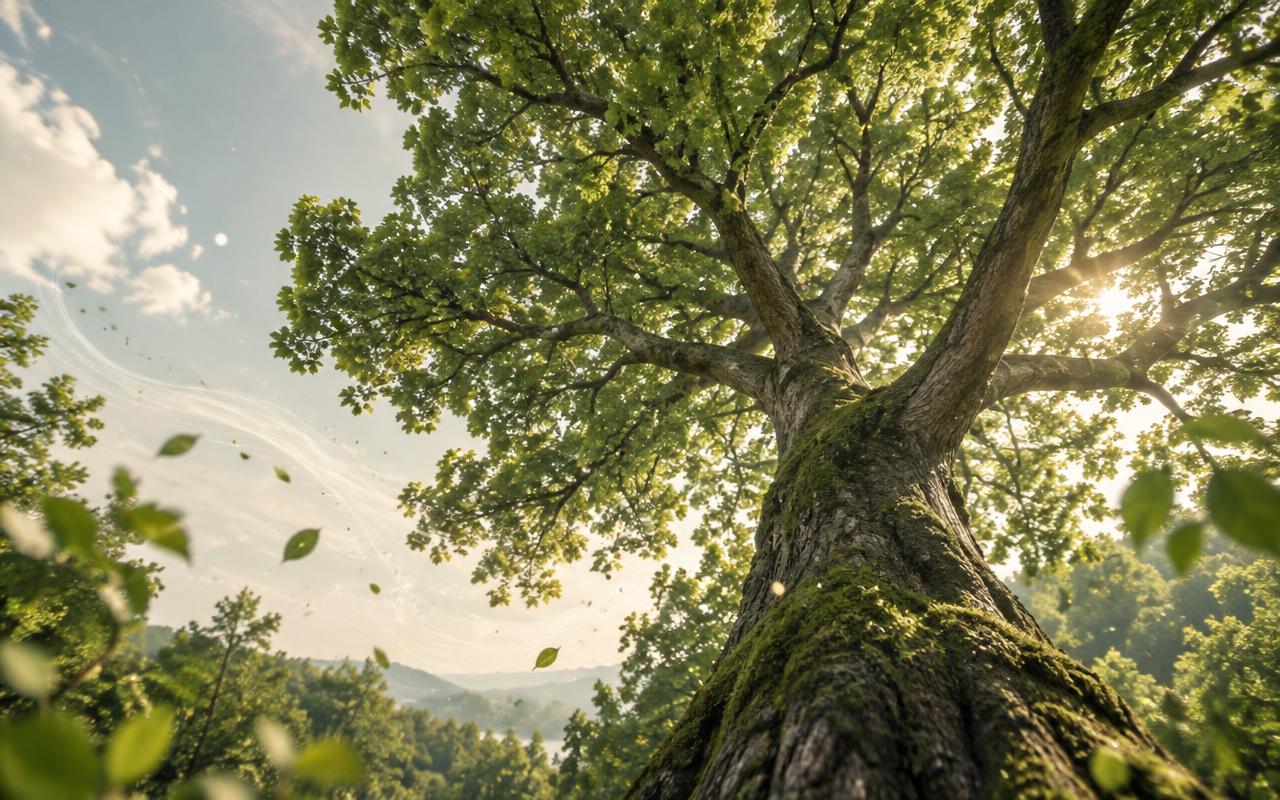
By contrast, a large mature oak or eucalyptus several decades old can sequester well over 100 kg of CO2 in a single year, simply because it has vastly more living wood laying down new growth rings. A single average figure hides a curve, not a flat rate.
What actually changes the number
Four factors matter more than any headline figure:
- Species — fast-growing broadleaf trees generally sequester more per year than slow-growing conifers of the same age
- Age and size — sequestration rises for decades as the tree grows, then plateaus in very old trees
- Climate and water — a stressed, drought-limited tree grows less wood and stores less carbon
- Survival — a tree that dies in year two stored close to nothing; only a surviving, maturing tree compounds
Putting it next to a real footprint
Average annual per-person emissions vary enormously by country — commonly cited estimates run from around 4–5 tonnes CO2 per year globally, to roughly 5–6 tonnes in the UK, up toward 14–15 tonnes in the US, driven mostly by energy mix, transport and heating.
At a working average of 20–25 kg per tree per year, offsetting even one tonne of annual emissions with newly planted trees would take dozens of trees — and, critically, years for them to reach that rate. Planting is a long-term compounding investment, not an instant transaction.
The honest framing
None of this makes planting pointless — quite the opposite. A tree that survives to maturity keeps absorbing carbon for decades, cools the street beneath it, and adds canopy that filters particulate pollution the whole time. The mistake is treating 'one tree = X kg of CO2, done' as a receipt rather than what it really is: the start of a decades-long process that only pays off if the tree survives, which is why aftercare matters as much as the planting itself.
Put it into practice
See the canopy and air quality of your own street, then plant what it's missing.
Analyse my area →